
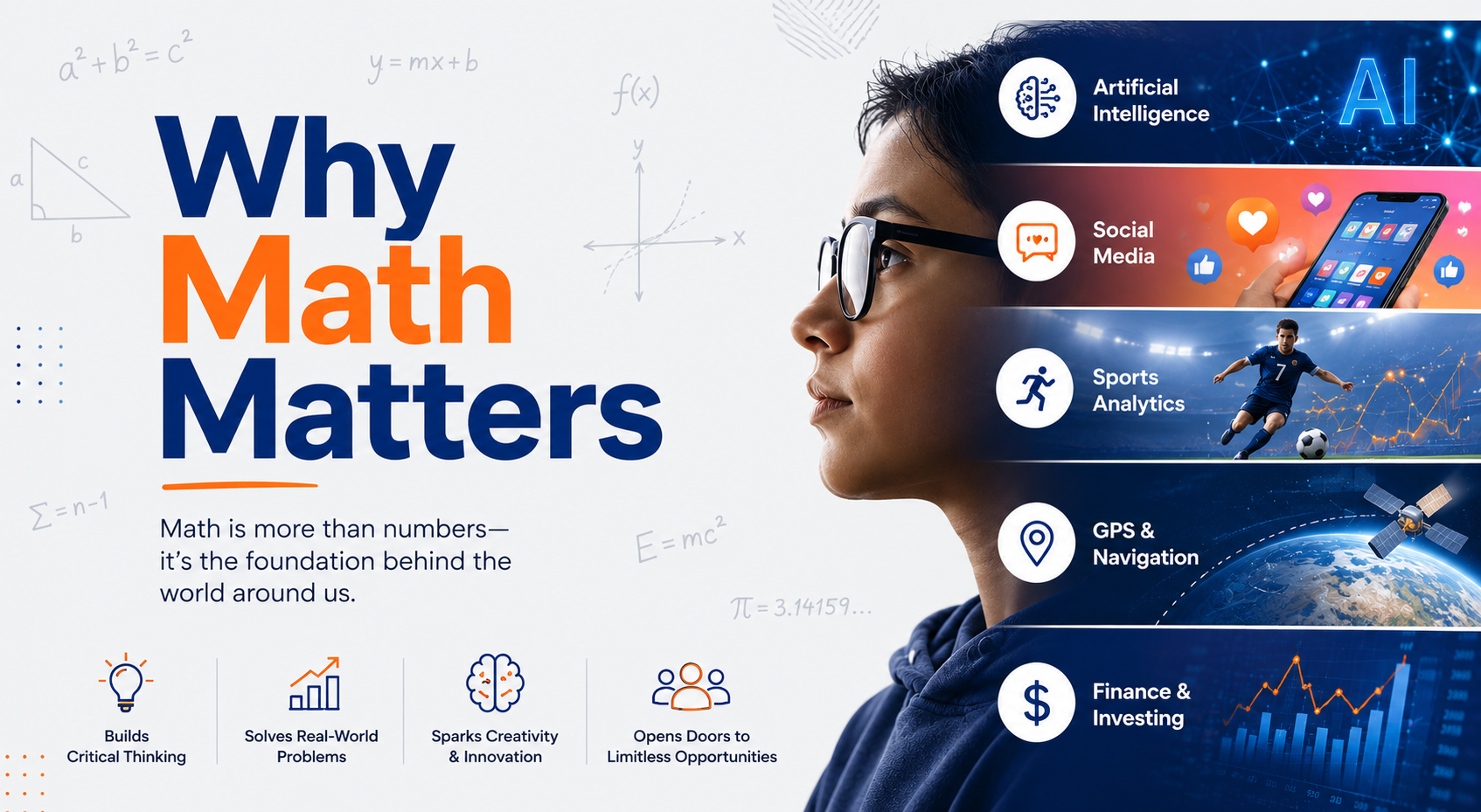
Why Math Matters
Math is everywhere. From the apps we use every day to the technology that powers modern life, mathematics plays a critical role in shaping the world around us. Understanding why math matters helps students see that math is much more than memorizing formulas or solving equations in school. Math develops logical thinking, problem-solving skills, analytical reasoning, and the ability to recognize patterns—skills that are valuable in every career and every stage of life.
At North Texas Math, we believe understanding why math matters begins with seeing how mathematics connects to the real world. When students can connect classroom concepts to technology, science, sports, finance, and everyday decisions, math becomes more meaningful, engaging, and easier to understand.
Math in Everyday Life
Many students ask, “When will I ever use this?” The truth is that math in everyday life is everywhere, even when we do not notice it. We use math when budgeting money, comparing prices, cooking recipes, planning schedules, measuring distances, calculating discounts, or analyzing statistics in sports.
Even simple activities involve mathematical thinking:
Estimating travel time
Calculating discounts while shopping
Splitting restaurant bills
Understanding interest rates
Managing savings and investments
Comparing prices and determining value
Planning time and resources
These are all examples of the real-world applications of math. Learning how mathematics works in practical situations helps students become more confident decision-makers and better problem solvers.
For students who want to explore more examples of how mathematics connects to technology and everyday life, the Society for Industrial and Applied Mathematics offers its Math Matters, Apply It! resources for K–12 students.
The Math Behind AI
Artificial intelligence is one of the most exciting examples of why math matters in the modern world. AI systems rely on algebra, probability, statistics, calculus, and data analysis to recognize patterns, process information, and make predictions.
Whether it is voice assistants, recommendation systems, facial recognition, or self-driving technology, mathematics plays an important role in the technology behind these systems.
Students often think AI is only about coding, but coding itself depends heavily on mathematical thinking, logic, patterns, and problem-solving.
Continue reading: The Ghost in the Machine: Why AI Is Actually Just Really Fast Math
The Math Behind Social Media
Social media platforms use mathematics constantly. Algorithms analyze likes, comments, shares, watch time, and other patterns in user behavior to determine which content is more likely to appear in your feed.
Probability, statistics, data analysis, and mathematical modeling help platforms make predictions about what users may be interested in.
Understanding the math behind social media helps students realize that mathematics directly influences the digital world they interact with every day. It also shows why math matters beyond the classroom.
Read more: Rewriting the Algorithm: How Math Shapes Your Social Media Feed
The Math Behind Video Games
Video games rely heavily on mathematics. Geometry helps create realistic movement and graphics, probability influences game mechanics, and physics engines use mathematical models to simulate motion, speed, gravity, and collisions.
From simple mobile games to advanced virtual reality environments, mathematics plays a critical role in game design and development.
Students who enjoy gaming are often surprised to discover how much real-world math is involved in creating their favorite games. This is another example of why math matters in technology and creative fields.
Continue reading: The Math Behind Video Games
The Math Behind Sports Analytics
Sports analytics has become an important part of professional athletics. Teams use statistics, probability, geometry, and data analysis to evaluate player performance, identify patterns, and develop strategies.
For example:
Basketball teams analyze shooting percentages
Soccer teams track movement patterns
Baseball teams calculate player statistics and efficiency
Racing teams use physics and data analysis to improve performance
These examples demonstrate the importance of math applications in competitive sports. They also show students that mathematical thinking can be applied to subjects they already enjoy.
Read more: The Math Behind Sports Analytics
Why Learning Math Is Important
Understanding why math matters is about more than preparing for tests. Math teaches students how to think critically, approach challenges logically, recognize patterns, evaluate information, and work through problems step by step.
These skills are useful in a wide range of careers, including:
Engineering
Medicine
Computer science
Finance
Architecture
Data science
Aviation
Cybersecurity
Artificial intelligence
Technology
According to the Society for Industrial and Applied Mathematics (SIAM), applied mathematics and related mathematical fields contribute to science, engineering, industry, technology, finance, healthcare, and many other areas.
Math is therefore not simply a school subject. It is a practical tool for understanding and solving real-world problems.
Math Builds Confidence
One of the most important reasons why math matters is the confidence it can build. Students who understand mathematics develop greater confidence in their ability to solve difficult problems, reason independently, and approach unfamiliar situations.
At North Texas Math, we focus on helping students truly understand concepts rather than simply memorize procedures. When students understand the logic behind mathematics and see its connection to the real world, they become more engaged and motivated learners.
This is one reason we emphasize problem-solving, critical thinking, multiple approaches, and explaining why a solution works—not just finding an answer.
Why Math Matters for the Future
The future will increasingly depend on technology, data, automation, and innovation. Careers related to artificial intelligence, robotics, cybersecurity, software development, engineering, data science, and other STEM fields require strong mathematical and analytical thinking.
Understanding the real-world applications of math today can help prepare students for opportunities tomorrow. The ability to analyze information, recognize patterns, evaluate possibilities, and solve complex problems will remain valuable in a rapidly changing world.
The more students understand why math matters, the more they can begin to see mathematics as a powerful tool rather than an obstacle.
Math is not just a school subject. It is part of the language behind science, technology, finance, innovation, sports, and modern life.
That is why math matters.
Set your child up for success with North Texas Math! Our small group classes introduce advanced concepts early, build real understanding, and boost confidence—grades 1–10. Enroll today!