
Gap Year Algebra: Keep Your Algebra Skills Strong While Taking Geometry
Don’t Let a Year Away from Algebra Become a Step Back
You worked hard to master Algebra 1. You learned how to solve equations, work with functions, manipulate expressions, interpret graphs, and use algebra to solve real problems. Then Geometry begins. For many students, this means that Algebra suddenly becomes something they used to do rather than something they continue to practice.
A year later, Algebra 2 starts—and students are expected to remember the algebra skills they learned before Geometry while simultaneously learning new and more challenging concepts.
That is the idea behind Gap Year Algebra at North Texas Math.
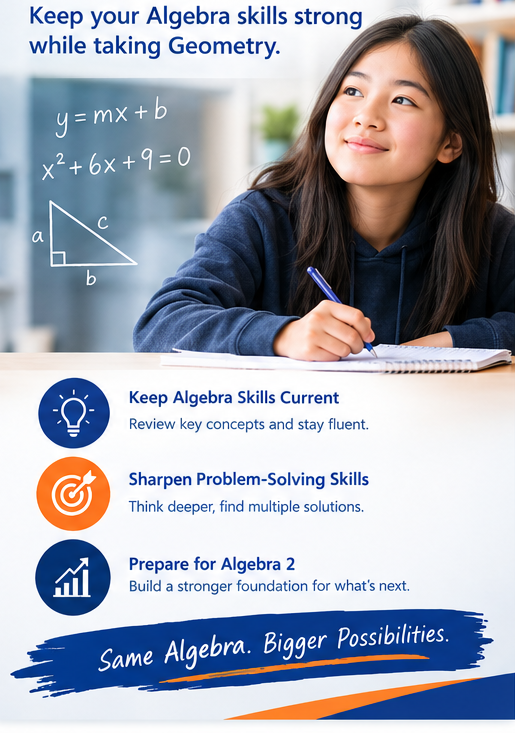
Our online Gap Year Algebra program is designed for students who have completed Algebra 1 and are taking Geometry. Instead of allowing algebra skills to sit unused for an entire school year, students continue working with algebra throughout the year while also developing stronger problem-solving and mathematical reasoning skills.
The goal is not to repeat Algebra 1. The goal is to keep Algebra current, sharpen existing skills, and build a stronger bridge to Algebra 2.
The purpose of Gap Year Algebra is to take the Algebra knowledge students already have and make it stronger.
Students will encounter familiar concepts again—but with increasing depth and complexity.
The goal is progression, not repetition.
Students should finish the year with a stronger sense of how Algebra works, not simply a longer list of procedures they have memorized.
Why Keep Practicing Algebra During Geometry?
Geometry and Algebra may look like two completely different subjects, but they are deeply connected. Geometry involves equations, variables, graphs, formulas, proportional reasoning, coordinate geometry, systems of equations, and algebraic manipulation. Students may use Algebra without even realizing that they are using it.
The challenge is that the Algebra students need for Geometry is not always the same Algebra they will need later in Algebra 2.
A student might successfully complete Algebra 1, spend an entire year concentrating primarily on Geometry, and then discover that familiar algebra procedures no longer feel automatic.
The issue isn’t necessarily that the student has “forgotten everything.” Rather, skills that were once practiced frequently may no longer be as fluent. Mathematics is cumulative. New concepts build on previous concepts, and students often need to retrieve older skills while learning new ones.
That is why continued practice matters.
The U.S. Department of Education’s Institute of Education Sciences (IES) recommends spacing learning over time and using interleaved practice to support learning and retention. Research summarized by IES has found that distributing mathematics practice over time and revisiting previously learned skills can improve longer-term retention.
For more information, see the IES What Works Clearinghouse practice guide on organizing instruction and study to improve student learning.
At North Texas Math, we apply these principles to Algebra. Instead of putting Algebra away for a year, students keep using it. They continue practicing important Algebra 1 skills, strengthen problem-solving fluency, and gradually prepare for the demands of Algebra 2.
What Is Gap Year Algebra?
Gap Year Algebra is an online math enrichment program for students who have completed Algebra 1 and are taking Geometry.
It fills the space between Algebra 1 and Algebra 2. Students continue practicing important Algebra 1 skills while gradually working toward more advanced algebraic thinking. The program is designed around three goals:
- Keep Algebra Skills Current
Students regularly revisit important Algebra concepts so that they remain familiar and usable. The purpose is not simply to give students more worksheets. Students need opportunities to retrieve, explain, apply, and connect algebraic ideas.
- Sharpen Algebra Skills
Knowing how to solve a problem once is not the same as being fluent with the mathematics. Strong mathematical skills involve recognizing structures, selecting appropriate strategies, explaining reasoning, and moving between different representations. Rather than memorizing isolated procedures, students learn to recognize the relationships within algebraic expressions and equations.
This type of mathematical thinking becomes increasingly important as students move into Algebra 2, advanced mathematics, and eventually courses such as precalculus and calculus.
- Prepare for Algebra 2
One of the biggest reasons to maintain Algebra skills during Geometry is simple: Algebra 2 comes next.
Students entering Algebra 2 are expected to have a working knowledge of Algebra 1. They don’t start from zero. If basic algebraic procedures require significant mental effort again, students have less mental energy available for the new concepts they are learning.
Gap Year Algebra is designed to help students enter Algebra 2 with their Algebra foundation still active. Instead of spending the beginning of Algebra 2 trying to remember how to solve equations, factor expressions, manipulate fractions, or work with functions, students can spend more time learning the new material.
Algebra Is a Foundation for Future Mathematics
Algebra is not just another high school math course. It is a foundation for the mathematics that follows.
The National Mathematics Advisory Panel identified algebra as a critical component of the mathematics pathway and emphasized the importance of developing both conceptual understanding and procedural fluency.
The Institute of Education Sciences also describes Algebra as a gateway course in the sequence of mathematics and science courses that can lead toward higher-level mathematics.
That sequence matters. A typical high school mathematics pathway may look something like:
Algebra 1 → Geometry → Algebra 2 → Precalculus → Calculus
The exact sequence varies by school, but the underlying principle remains the same:
Students build new mathematical knowledge on top of previously learned mathematics.
If a foundational skill becomes rusty, later mathematics can become unnecessarily difficult. That doesn’t mean every student needs to take an additional Algebra class between Algebra 1 and Algebra 2. It means that students who want to maintain a strong algebra foundation can benefit from deliberately continuing to practice Algebra while Geometry is their primary school mathematics course.
Why North Texas Math?

At North Texas Math, we believe mathematics should be understood—not simply memorized. Our approach emphasizes reasoning, structure, problem solving, and mastery. Students are encouraged to explain their thinking and understand why a method works.
We also believe there is rarely just one interesting way to approach a mathematical problem. Students may be asked to compare strategies, find patterns, look for alternative solutions, and explain their reasoning.
That approach is especially valuable during a year when students are studying Geometry. Geometry itself encourages students to think about relationships, structure, logic, and proof. Gap Year Algebra complements that experience by keeping algebraic reasoning active at the same time.
The result is not simply more Algebra practice. It is an opportunity to become a stronger mathematical thinker.
Set your child up for success with North Texas Math! Our small group classes introduce advanced concepts early, build real understanding, and boost confidence—grades 1–10. Enroll today!